


The fire protection properties of the coating comply with the requirements of GOST R 53295-2009.
Fire-retardant paint, or Bronya Fire Protection (R45, R60, R90, R120), is used to qualitatively improve the fire safety of building envelopes. The simplicity of applying the protective material eliminates the need for additional installation work. Fire-retardant paints are reliable and durable, which is why fire protection using paint is convenient and practical. This is especially relevant for hard-to-reach places—dismantling is not required for repeated fire protection work.
Dependence of the "BRONYA FIRE PROTECTION" coating thickness (mm) on the required fire resistance limit (R) and the reduced metal thickness (RMT)
|
Reduced thickness of the steel structure, mm
|
Fire resistance limit, min |
|||||||
|
45 |
60 |
90 |
120 |
|||||
|
thickness, mm |
consumption, kg/m² |
thickness, mm |
consumption, kg/m² |
thickness, mm |
consumption, kg/m² |
thickness, mm |
consumption, kg/m² |
|
| 2.4 | 1.2 | 1.69 | 1.53 | 2.155 | - | - | - | - |
| 3.4 | 1.07 | 1.59 | 1.38 | 2.03 | 2.0 | 2.82 | - | - |
| 5.8 | 0.62 | 0.87 | 0.81 | 1.142 | 1.76 | 2.61 | - | - |
| 7.2 and more | 0.65 | 0.95 | 0.85 | 1.25 | 1.3 | 1.83 | 2.3 |
3.2 |
Experiment with the BRONYA FIRE PROTECTION fire-retardant composition.
Advantages of the Bronya fire-retardant composition
- Favorable market cost;
- Low consumption with very high fire-retardant and physico-mechanical characteristics;
- When used together with LCTI (Liquid Ceramic Thermal Insulation), it does not degrade the thermophysical properties of the coating (including those of competing brands) and allows the system to achieve an NF (non-flammable) combustibility group;
- Unlike analogues, the "Bronya-Fire Protection" composition can be tinted without degrading the fire resistance of the coating; A cost-effective solution for fire protection tasks;
- Reduction in labor costs and the overall cost of work;
- The coating (without an additional protective layer) is designed for indoor operation for 30 years;
- The quality of the "Bronya-Fire Protection" composition allows for something that was until recently considered impossible in Russia: protecting light metal structures up to an R120 rating. The composition was specially developed for use on sports and infrastructure facilities where, despite a large building area, the load on the enclosing structures is low, and the reduced thicknesses of the load-bearing metal are small. At the same time, the traditional advantages of "Bronya-Fire Protection" are fully preserved - low consumption, ease of application, and a long service life of the coating.
The fire protection tasks for each object are different. Our specialists help to select the optimal solution for each object. Recommendations for the choice of a protective system, development of special technical conditions, expert approvals, and calculations. The specialists of our engineering and technical department provide consultations on both the design solutions for the fire safety section and on the preparation and execution of the work - and in some cases, our consultations have allowed the client to significantly reduce fire protection costs.
Operating Principle of Bronya-Fire Protection
When heated, vapors and inert gases are released that do not support and slow down combustion, creating a protective displacement of oxygen with gases and vapors. Thus, fire-retardant paints not only block thermal convection at the protected surface but also significantly reduce and suppress the flame. At the same time, the top layer of the protected surface thickens, chars, and acquires the necessary rigidity. The paint contains flame retardants, specialized gas-forming agents, foam layer stabilizers, and heat-resistant substances based on a polymer binder.
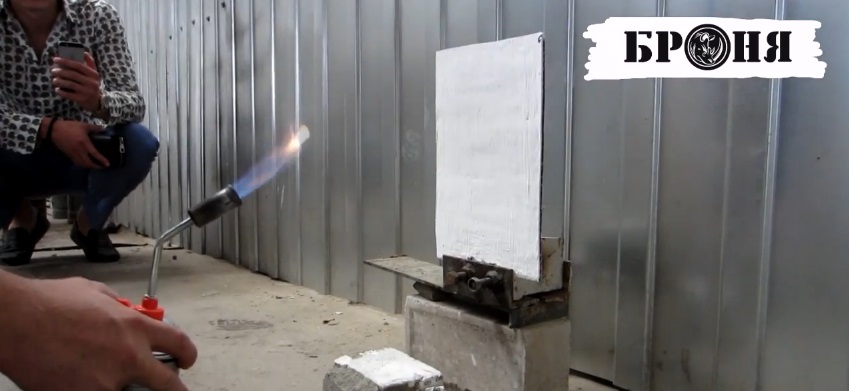 Fire-retardant composition "Bronya Fire Protection" - before fire exposure
  Fire-retardant composition "Bronya Fire Protection" - after fire exposure
Area of Application
- Metal structures of oil refinery infrastructure;
- Facilities of chemical enterprises, including those that are a source of exposure to low- and medium-aggressive acidic or alkaline environments;
- Open and closed parking garages, mezzanines, overpasses;
- Civil construction objects without any restrictions;
- Other objects where the use of fire-retardant paints without topcoats is practical.
- air temperature — +5 to +35 °C;
- relative air humidity - not more than 80 %;
- the difference between the air temperature and the dew point is more than 3 °C;
- no atmospheric precipitation;
- atmospheric condition — according to GOST 17.2.3.02.
- Increases the fire resistance limit (R) of the coated structures, from R45 to R120. The thickness is selected using Tables 1 and 2.
- When used together with LCTI, it does not degrade the thermophysical properties of the coating (including those of competing brands) and allows the system to achieve an NF combustibility group.
- Unlike analogues, the "Bronya-Fire Protection" composition can be tinted without degrading its fire resistance.
- It has a common base with Bronya LCTI, which makes it possible, when used together, to obtain an ideal non-combustible "Bronya NF" system with excellent fire resistance, physical, and thermophysical properties.
- Possibility of use for fire protection and thermal insulation of both metal structures (with the use of LCTI "Bronya Classic" and "Bronya Antirust") and building envelopes (with the use of "Bronya Facade" and "Bronya Winter").
- The coating (without an additional protective layer) is designed for indoor operation for 30 years.
- Coating group according to GOST 9.032 - special (5/3).
- The color of the fire-retardant coating is white, the shade is not standardized, the composition can be tinted by no more than 1%.
- The color of the additional (protective, decorative) layer is not regulated.
- Fire protection efficiency group according to GOST R 53295 - 2.
- Fire resistance limit provided by the coating according to GOST 30247 - R15...R120.
- The fire protection properties of the coating comply with the requirements of GOST R 53295 "Fire-retardant agents for steel structures. General requirements. Method for determining fire protection efficiency," GOST 30247.1 "Building structures. Fire resistance test methods. Load-bearing and enclosing structures."
Technical characteristics of the "Bronya-Fire Protection" fire-retardant composition
| No. | Indicator Name | Standard for the brand |
|---|---|---|
| 1 | Appearance | White, thick, homogeneous mass, forms a matte coating upon drying |
| 2 | Mass fraction of non-volatile substances, %, not less than | 50 |
| 3 | Drying time to degree 3 at a temperature of (20±2)°C, h., not more than | 1 |
| 4 | Dynamic viscosity (Brookfield), mPa·s, not less than | 17000 |
| 5 | Degree of grinding, µm, not more than | 50 |
| 6 | Coating's ability to peel | Should not peel from the metal |
Application of the fire-retardant composition
Recommended primers: GF-021 or Epiprime-046
Methods: brush, spatula, "Graco" airless sprayers
Application work should be carried out under the following conditions:
Inter-layer drying: 5-6 hours to degree "3" at 20°C
 Bronya Fire Protection. Application by brush.
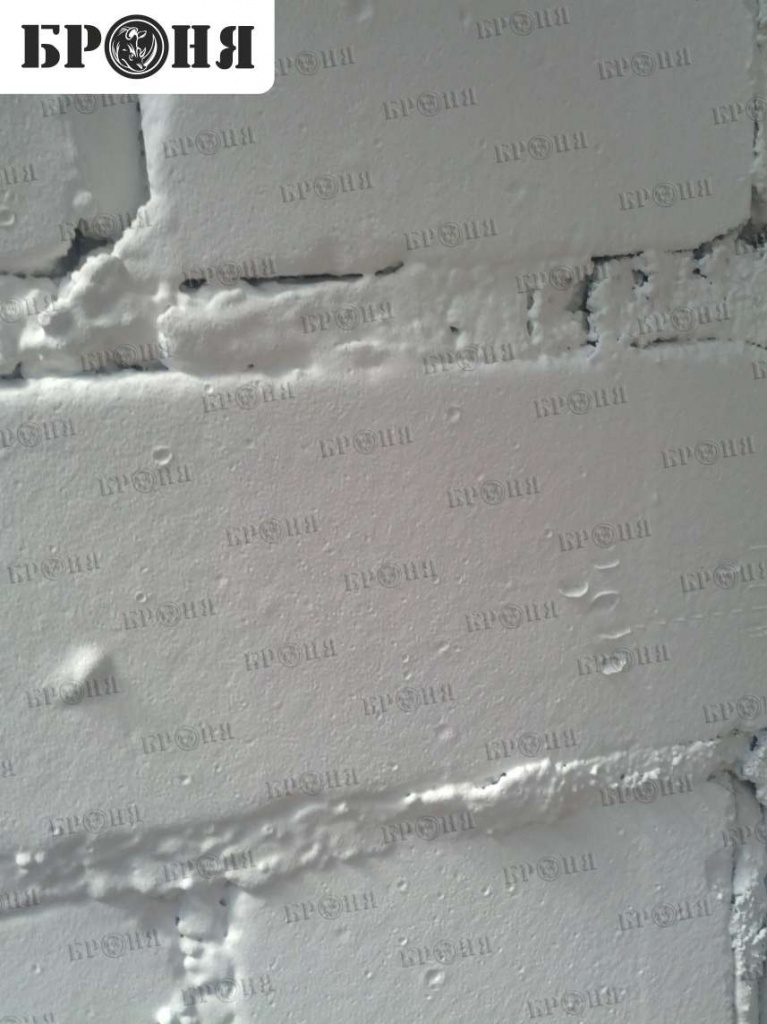 Bronya Fire Protection Application with a Graco unit.
Combined application of the "Bronya-Fire Protection" composition and liquid ceramic thermal insulation coatings of the Bronya series.
The fire-retardant and thermal insulation coating based on the "Bronya Fire Protection" composition is a system consisting of a primer from the series of special Bronya coatings, a Bronya liquid ceramic thermal insulation coating, the "Bronya Fire Protection" coating, and an additional (protective) layer of Bronya water repellent.
"Bronya Fire Protection" has the following advantages:
Dependence of the dry layer thickness of the "Bronya Fire Protection" coating on the required fire resistance limit and the reduced metal thickness.
Tabular representation of the dependence of the "Bronya Fire Protection" coating thickness on the required fire resistance limit (R) and the reduced metal thickness (RMT).
|
Reduced thickness of the steel structure, mm |
Fire resistance limit, min |
|||||||
|
45 |
60 |
90 |
120 |
|||||
| thickness, mm | consumption, kg/m² | thickness, mm | consumption, kg/m² | thickness, mm | consumption, kg/m² | thickness, mm | consumption, kg/m² | |
|
2.4 |
1.2 |
1.69 |
1.53 |
2.15 |
- |
- |
- |
- |
|
2.6 |
1.21 |
1.8 |
1.56 |
2.29 |
- |
- |
- |
- |
|
2.8 |
1.18 |
1.74 |
1.51 |
2.22 |
- |
- |
- |
- |
|
3 |
1.14 |
1.69 |
1.47 |
2.16 |
- |
- |
- |
- |
|
3.2 |
1.11 |
1.64 |
1.42 |
2.09 |
- |
- |
- |
- |
|
3.4 |
1.07 |
1.59 |
1.38 |
2.03 |
2 |
2.82 |
- |
- |
|
3.6 |
1.04 |
1.53 |
1.34 |
1.96 |
2.26 |
3.33 |
- |
- |
|
3.8 |
1 |
1.48 |
1.29 |
1.9 |
2.21 |
3.27 |
- |
- |
|
4 |
0.97 |
1.43 |
1.25 |
1.83 |
2.17 |
3.2 |
- |
- |
|
4.2 |
0.93 |
1.37 |
1.2 |
1.77 |
2.12 |
3.14 |
- |
- |
|
4.4 |
0.9 |
1.32 |
1.16 |
1.7 |
2.08 |
3.07 |
- |
- |
|
4.6 |
0.86 |
1.27 |
1.11 |
1.64 |
2.03 |
3.01 |
- |
- |
|
4.8 |
0.83 |
1.21 |
1.07 |
1.57 |
1.99 |
2.94 |
- |
- |
|
5 |
0.79 |
1.16 |
1.03 |
1.51 |
1.94 |
2.87 |
- |
- |
|
5.2 |
0.76 |
1.11 |
0.98 |
1.44 |
1.9 |
2.81 |
- |
- |
|
5.4 |
0.72 |
1.06 |
0.94 |
1.38 |
1.85 |
2.74 |
- |
- |
|
5.6 |
0.69 |
1 |
0.89 |
1.31 |
1.81 |
2.68 |
- |
- |
| 5.8 |
0.62 |
0.87 |
0.8 |
1.14 |
1.76 |
2.61 |
- |
- |
| 6 |
0.65 |
0.95 |
0.85 |
1.25 |
1.72 |
2.54 |
- |
- |
| 6.2 | 0.65 | 0.95 | 0.85 | 1.25 | 1.67 |
2.48 |
- |
- |
| 6.4 | 0.65 | 0.95 | 0.85 | 1.25 | 1.63 |
2.41 |
- |
- |
| 6.6 | 0.65 | 0.95 | 0.85 | 1.25 |
1.58 |
2.35 |
- |
- |
| 6.8 | 0.65 | 0.95 | 0.85 | 1.25 |
1.54 |
2.28 |
- |
- |
| 7 | 0.65 | 0.95 | 0.85 | 1.25 |
1.49 |
2.22 |
- |
- |
| 7.2 and more | 0.65 | 0.95 | 0.85 | 1.25 |
1.3 |
1.83 |
2.3 |
3.2 |
Combined structural fire protection consisting of liquid ceramic thermal insulation coatings of the "Bronya" series, "Bronya Classic NF", and the fire-retardant composition "Bronya-Fire Protection" with a thermal conductivity coefficient of 0.001 W/(m·°C) is intended to increase the fire resistance limit of steel structures and facilities for industrial and civil purposes from 120 to 240 minutes.
The fire protection properties of the coating comply with the fire safety requirements of GOST R 53295-2009 "Fire retardants for steel structures. General requirements. Method for determining fire protection efficiency."
Combined Structural Fire Protection is used for the qualitative improvement of the fire safety of building envelopes, confirms the possibility of using a combination of our products instead of traditional structural fire protection systems, as well as its application on parts of objects where it was previously a challenge and not considered possible.
The advantages of using the proposed highly effective combined structural fire protection are:
- a structural fire protection limit from 120 min to 240 min is provided;
- the thermophysical properties of the coating are not degraded, the calculated thermal conductivity coefficient of 0.001 W/(m·°C) is maintained when applying fire-retardant coatings before fire operation.
- the thermal insulation coating has an NF (non-flammable) combustibility group, which increases the overall fire resistance of the combined structural fire protection;
- the possibility of simple installation of structural fire protection - mechanical or machine application similar to painting work;
- the ability to protect structures of any complex shape;
- no additional load on the supporting structures due to the small thickness and low weight of the coatings.
Combined structural fire protection consisting of the fire-retardant composition "Bronya-Fire Protection" and a liquid ceramic thermal insulation coating of the "Bronya" series: Bronya Classic NF, confirmed by Certificate of Conformity No. ССБК.RU.ПБ33.H00405 dated 25.05.2023, is capable of increasing the following fire resistance limits of a structure:
- Bronya-Fire Protection not less than 1.50 mm + Bronya Classic NF not less than 1.50 mm – R 120.
- Bronya-Fire Protection not less than 4 mm + Bronya Classic NF not less than 4 mm with an additional reinforcing layer of geotextile, fiberglass mat, or fiberglass fabric – R 240 .
Dependence of the thickness of the Combined structural fire protection consisting of the fire-retardant composition "Bronya-Fire Protection" and a liquid ceramic thermal insulation coating of the "Bronya" series: Bronya Classic NF (mm) on the required fire resistance limit (R)
and the reduced metal thickness (RMT)
|
Fire resistance limit, min.
|
|||||||||
|
Reduced thickness of the steel structure, mm
|
120 |
Reduced thickness of the steel structure, mm
|
240 |
||||||
|
thickness, |
consumption, *l/m² |
thickness, |
consumption, *l/m² |
||||||
|
Bronya-Fire Protection |
Bronya Classic NF |
Bronya-Fire Protection |
Bronya Classic NF |
Bronya-Fire Protection |
Bronya Classic NF |
Bronya-Fire Protection |
Bronya Classic NF |
||
|
5.8 |
1.5 |
1.5 |
2.1 |
1.5* |
7.2 |
4 |
4 |
5.6 |
4* |
Area of Application
Metal structures of oil refinery infrastructure;
Facilities of chemical enterprises, including those that are a source of exposure to low- and medium-aggressive acidic or alkaline environments;
Open and closed parking garages, mezzanines, overpasses;
Civil construction objects without any restrictions;
Other objects where the use of fire-retardant paints without topcoats is practical.
1.4 Proposed "Structural Fire Protection" schemes: 120 min., 150 min., 180 min., 240 min.
- Liquid thermal insulation coating of the "Bronya" series with a thermal conductivity coefficient of 0.001, Bronya Classic NF, produced according to TC 2216-006-09560516-2013 with amendment No. 1, 1 mm thick + "Bronya Fire Protection" 3 mm (with additional reinforcement of fiberglass mat, between the non-combustible LCTI and the Fire Protection). This will allow us to interpolate for your required metal thickness and achieve - R120;
- Liquid thermal insulation coating of the "Bronya" series with a thermal conductivity coefficient of 0.001, non-combustibility class NF, produced according to TC 2216-006-09560516-2013 with amendment No. 1, 2 mm thick + "Bronya Fire Protection" 2 mm on 5.8 mm metal (with additional reinforcement of fiberglass mat, between the non-combustible LCTI and the Fire Protection) - R150;
- Liquid thermal insulation coating of the "Bronya" series with a thermal conductivity coefficient of 0.001, non-combustibility class NF, produced according to TC 2216-006-09560516-2013 with amendment No. 1, 3 mm thick + "Bronya Fire Protection" 3 mm on 3.4 mm metal (with additional reinforcement of fiberglass mat, between the non-combustible LCTI and the Fire Protection) - R180.
- Bronya-Fire Protection, produced according to TC 1523-007-09560516-2014, not less than 1.50 mm + Bronya Classic NF with a thermal conductivity coefficient of 0.001, non-combustibility class NF, produced according to TC 2216-006-09560516-2013, not less than 1.50 mm thick – R 120 (reduced metal thickness 5.8 mm).
- Bronya-Fire Protection, produced according to TC 1523-007-09560516-2014, not less than 4 mm + Bronya Classic NF with a thermal conductivity coefficient of 0.001, non-combustibility class NF, produced according to TC 2216-006-09560516-2013, not less than 4 mm with an additional reinforcing layer of geotextile, fiberglass mat, or fiberglass fabric – R 240 (reduced metal thickness 7.2 mm).
1.5. Additionally, add information about the 12th Patent. A new, 12th Bronya patent has been obtained - "Highly effective combined structural fire protection based on a combination of non-combustible ultra-thin thermal insulation based on hollow microspheres and a fire-retardant coating."
https://nano34.ru/news/vazhno-poluchen-novyy-12-yy-patent-bronya-vysokoeffektivnaya-kombinirovannaya-konstruktivnaya-ogneza/